
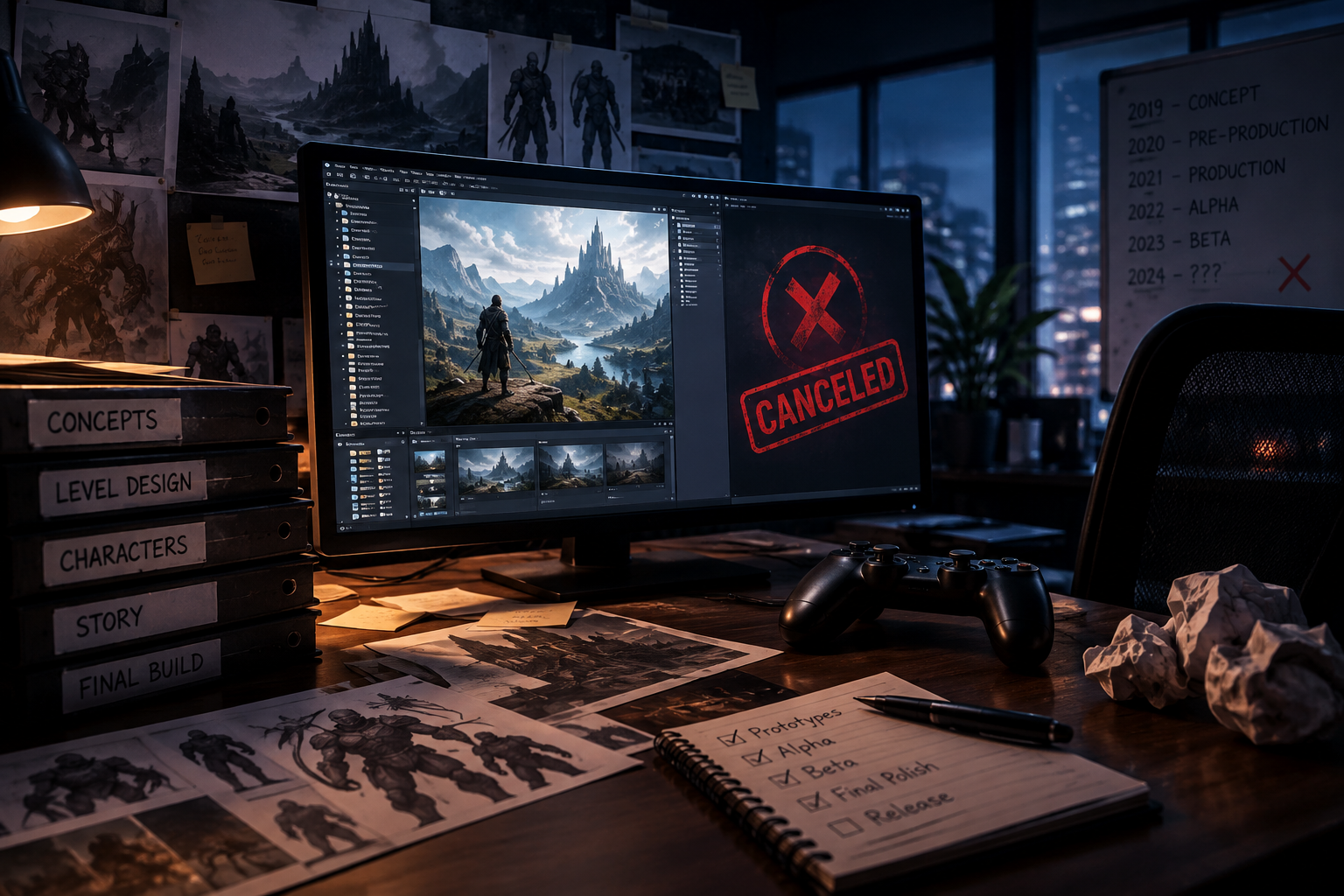
What Happens When a Video Game Is Canceled After Years of Development?
Imagine spending several years creating a video game.
Hundreds of people have worked on it.
Thousands of hours have been invested.
Characters have been designed. Maps have been built. Music has been recorded. Trailers may have already been produced.
And then, one day, the project is canceled.
The game will never be released.
For players, it can be disappointing.
For the developers who worked on it, the situation can be much more complicated.
But what actually happens when a video game is canceled after years of development?
Where does all that work go?
And why would a company abandon a game after investing so much time and money into it?
Why Do Video Games Get Canceled?
There isn’t a single reason why a game gets canceled.
Sometimes the project becomes too expensive.
Sometimes development takes much longer than expected.
A game’s technology may become outdated.
The company might change its strategy.
The market can change.
A publisher might lose confidence in the project.
Or the developers may realize that the game simply isn’t becoming what they originally planned.
In some cases, a project can survive for years through multiple versions before the company finally decides that continuing isn’t worth the investment.
Development Can Change Completely
Video game development rarely follows a perfectly straight path.
A project might begin as one type of game and slowly become something completely different.
Developers can create prototypes, test mechanics, remove features, rebuild systems, and completely change the direction of the project.
This process is normal.
The problem happens when the changes become too large.
A studio can eventually reach a point where continuing development would require rebuilding major parts of the game.
At that point, the company has to decide whether starting over or canceling the project makes more financial sense.
The Cost Keeps Growing
Large video games can require enormous budgets.
Developers need salaries, equipment, software, offices, technology, marketing, contractors, voice actors, musicians, testing, localization, and many other resources.
The longer a project remains in development, the more expensive it becomes.
This creates a difficult decision.
A company might already have spent a huge amount of money on a game.
But that doesn’t necessarily mean it should spend even more.
Sometimes continuing to invest in a struggling project could create an even bigger financial loss.
The Sunk Cost Problem
One of the hardest decisions for a company is accepting that previous investment cannot always be recovered.
Imagine a studio has already spent years developing a game.
It might feel logical to continue because so much work has already been completed.
But the money and time already spent are gone regardless of what happens next.
The real question becomes:
“Is the remaining investment likely to produce a successful game?”
If the answer is no, canceling the project can sometimes be the better business decision.
What Happens to the Developers?
When a game is canceled, the people who worked on it don’t necessarily disappear from the company.
They may be moved to another project.
A programmer might join a different team.
An artist might begin working on another game.
A designer could help develop a new concept.
Sometimes an entire team is reorganized.
However, cancellations can also happen during larger company restructurings, which can create much more serious consequences for employees.
For developers, losing a project they’ve worked on for years can be emotionally difficult even when they continue working at the same studio.
What Happens to the Game’s Assets?
This is where things get interesting.
A canceled game can leave behind an enormous amount of material.
There might be:
- Character models
- Concept art
- Animations
- Sound effects
- Music
- Scripts
- Storyboards
- Game environments
- Prototype levels
- Gameplay systems
- Technology
- Promotional material
Not everything is necessarily thrown away.
Some assets can be reused in future projects.
A character design might inspire a new character.
A gameplay system might become part of another game.
An environment could be redesigned for a completely different project.
In other cases, the material simply remains archived.
Sometimes the Technology Lives On
A canceled game can still contribute something important to a studio.
During development, programmers may create new tools and technologies.
These tools might eventually be used in another game.
For example, a team could develop a better animation system, rendering technology, artificial intelligence system, or world-building tool.
Even if the original game never launches, some of the technology created for it can survive.
In that sense, a canceled project isn’t always completely wasted.
What Happens to the Story?
Stories can have an interesting fate.
A canceled game may have years of writing behind it.
Characters, locations, dialogue, and entire fictional worlds might already exist.
Sometimes these ideas disappear.
But occasionally, concepts from canceled projects return in another form.
A character could be redesigned.
A story concept could be adapted.
A mechanic could become the foundation of another game.
Players might never know how much of an abandoned project eventually influenced a released game.
Why Don’t Companies Release the Unfinished Game?
Players sometimes ask a simple question:
“If the game is already partly finished, why not release it?”
The problem is that “partly finished” doesn’t necessarily mean “playable.”
A game can have impressive environments and characters while still missing essential systems.
It might have serious bugs.
The story might be incomplete.
Performance might be unacceptable.
The gameplay loop might not be fun.
Online infrastructure might not exist yet.
Some components might only work inside development tools.
Releasing an unfinished game can create significant costs and damage a company’s reputation.
What About the Money Already Spent?
A canceled project can represent a major financial loss.
However, companies don’t always publicly reveal exactly how much money was spent.
Development budgets can involve multiple departments and external partners, making the true cost difficult to calculate from the outside.
There can also be additional expenses related to cancellation itself, including restructuring teams, ending contracts, or changing production plans.
That’s one reason cancellations are often major events inside a studio.
Sometimes the Public Never Knows
Not every canceled game becomes famous.
In fact, the public may never hear about many canceled projects.
A studio can experiment with several prototypes internally without announcing any of them.
If a prototype doesn’t work, it can simply be abandoned.
Players only discover these projects years later if developers talk about them, leaked material appears, or archived information becomes public.
This means there are probably many canceled games that most players will never know existed.
Leaks Can Reveal Lost Games
Sometimes canceled projects become known because unfinished material appears online.
Players might discover concept art, screenshots, videos, prototype footage, or other development material.
This can create enormous interest.
Fans start trying to understand what the game could have become.
However, unfinished material doesn’t always represent the final version of a project.
A screenshot from an early prototype might look completely different from what the developers originally intended to release.
The Mystery Makes Canceled Games Fascinating
There’s something unique about a game that never existed for players.
A released game can be reviewed, played, completed, criticized, and remembered.
A canceled game becomes a question.
What would it have been like?
Would it have been successful?
Could it have changed the industry?
Was it actually good?
Nobody can know for certain.
That’s why canceled games often develop a strange kind of mythology among gaming communities.
Some Canceled Games Are Reborn
Cancellation doesn’t always mean the end of an idea.
Sometimes a project is restarted under a different name.
Sometimes a studio completely changes the concept.
Sometimes another developer takes inspiration from the original project.
A canceled game can effectively become the foundation for something new.
The original version disappears, but parts of its DNA survive.
The Game Industry Is Full of Abandoned Ideas
For every major game that reaches players, there are countless ideas that never make it that far.
Developers constantly experiment.
Some ideas work.
Some don’t.
Some are too expensive.
Some aren’t fun.
Others simply arrive at the wrong time.
This is a normal part of creative development.
The difference is that players usually only see the successful projects.
The abandoned ones remain hidden behind the final product.
What Happens to the Project Files?
The answer depends on the studio and its policies.
Development files can be archived for historical or legal reasons.
Some material may be stored internally for years.
Other files might eventually be deleted or become inaccessible as technology changes.
In some cases, older projects can become difficult to recover because the hardware, software, or tools required to open them are no longer available.
A canceled game can therefore become lost not only creatively, but technologically.
Could Players Ever Play It?
Sometimes.
If a project is officially released later, revived, leaked, or preserved through legitimate archival efforts, players may eventually get a chance to see parts of it.
But many canceled games remain inaccessible.
Some are incomplete.
Some are legally protected.
Others are simply too broken to become a playable product.
That’s why discovering a playable prototype from an abandoned project can be such a big deal for gaming historians and fans.
Final Thoughts
When a video game is canceled after years of development, the result isn’t simply a missing game on a release calendar.
Behind that cancellation can be years of work, thousands of ideas, entire teams, unfinished technology, creative experiments, and enormous financial investment.
Some of that work disappears.
Some is archived.
Some becomes part of another game.
And occasionally, fragments of the original project resurface years later and give players a glimpse at what could have been.
The most fascinating thing about canceled games is that we’ll never know exactly what they might have become.
And sometimes, the games that never existed leave just as much of a mark on gaming history as the ones that were released.