
Graveyard Keeper 2 Review – A Bigger, Stranger and More Ambitious Cemetery
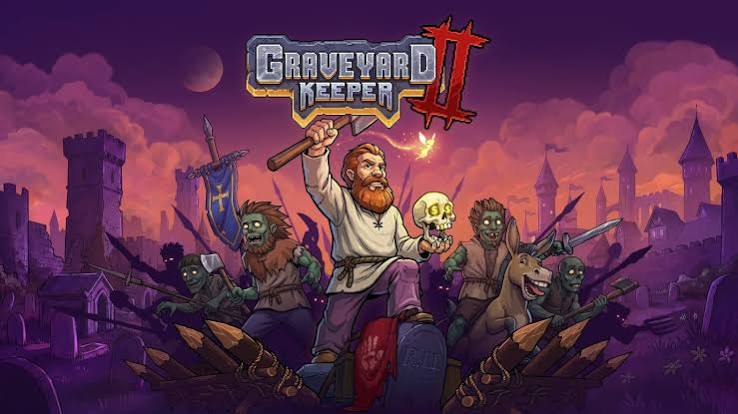
The graveyard business is back, and Graveyard Keeper 2 is once again turning something as grim as managing the dead into an unexpectedly entertaining management experience.
Developed by Lazy Bear Games and published by tinyBuild, the sequel takes the unusual formula of the original and expands it considerably. Instead of focusing exclusively on the cemetery, the game introduces town restoration, automation, undead workers and a much broader management system.
The result is a sequel that feels designed to give players considerably more freedom while maintaining the dark humor that made the original so distinctive.
This review is based on the game’s pre-release demo. The full version launches on September 22, 2026.
Gameplay
At its core, Graveyard Keeper 2 remains a management and simulation game.
The basic idea is simple: gather resources, build new structures, improve production and gradually turn your medieval operation into something much larger.
What makes the sequel interesting is how many of these systems are connected.
Resources can be transformed into new materials, production can be automated, and undead workers can take over some of the more repetitive tasks. This gives the game a satisfying sense of progression as the player’s operation becomes increasingly complex.
The automation system is particularly important because it changes the way you approach progression. Instead of personally handling every task, you can gradually build a system capable of taking care of work in the background.
That creates a nice management loop: expand, automate, improve and expand again.
Story
Graveyard Keeper 2 introduces a new role for the player as the Grand Inquisitor, while the world faces the threat of a zombie apocalypse.
The narrative keeps the series’ unusual sense of humor rather than taking its setting completely seriously.
The contrast between the dark medieval world and the absurd situations surrounding the player remains one of the game’s biggest sources of personality.
There is also a larger focus on rebuilding the town and helping its inhabitants. This gives the world more purpose beyond simply improving the cemetery.
Rather than feeling like a collection of disconnected systems, the town, cemetery and production mechanics are increasingly tied together.
Exploration
Exploration plays an important role in discovering resources, completing quests and expanding your operation.
The world encourages players to move between different activities instead of spending the entire game inside the cemetery.
This works particularly well for players who enjoy games where exploration is directly connected to progression.
There is always another resource to collect, another improvement to make or another part of the operation that can be developed.
Automation
Automation is one of the biggest additions to Graveyard Keeper 2.
The sequel allows undead workers to handle parts of the production process, reducing the amount of repetitive work the player has to perform manually.
This mechanic fits the game’s setting perfectly.
Instead of simply being another generic automation system, it becomes part of the game’s identity. Your growing operation can eventually function almost like a strange medieval factory powered by the undead.
The more systems become automated, the more attention you can dedicate to exploration, quests and expanding the town.
Town Management
The cemetery isn’t the only thing that needs attention.
Graveyard Keeper 2 also allows players to help rebuild the town and complete quests for its inhabitants.
This expands the management aspect beyond the graveyard itself and gives the player another long-term objective.
The town also creates a stronger sense of progression. As the player’s operation grows, the surrounding world can develop alongside it.
It is an effective way of making the sequel feel larger than the original rather than simply offering another collection of the same activities.
Graphics
Graveyard Keeper 2 maintains the distinctive visual identity associated with the series.
The 2.5D pixel-art presentation gives the game a colorful but deliberately strange appearance, while the medieval setting provides plenty of opportunities for dark humor.
The visual style isn’t trying to compete with modern photorealistic games.
Instead, it focuses on personality, readable environments and expressive characters.
That approach fits the game’s gameplay extremely well.
Audio
The audio design complements the game’s unusual atmosphere.
Rather than making the world feel excessively serious, the presentation supports the combination of medieval fantasy, management mechanics and dark comedy.
The overall result is an atmosphere that feels strange without becoming unnecessarily heavy.
Performance
The pre-release demo provides a solid look at the game’s general presentation and systems.
However, because the full game has not officially launched yet, the final performance across every supported platform should be evaluated after release.
This is particularly important for a game with several interconnected simulation and automation systems, where performance can vary depending on the scale of the player’s operation.
Playtime
The final playtime will depend heavily on how much of the game’s management, exploration and progression systems each player chooses to experience.
Graveyard Keeper 2 is built around long-term progression rather than a straightforward linear campaign.
Players who enjoy optimizing production, expanding their operations and completing optional activities should have considerably more to do than someone who focuses only on the main objectives.
✓ Positive Points
- Deep and interconnected management systems
- Interesting automation mechanics
- Strong visual identity
- Dark humor fits the setting
- Town restoration expands the original formula
- More freedom in how you approach progression
- Undead workers add personality to the automation system
× Negative Points
- The number of interconnected systems can feel overwhelming
- Some repetitive management remains part of the experience
- The full game’s final performance still needs to be evaluated after launch
- Players looking for a traditional action-focused RPG may find the management systems slow-paced
★ Final Verdict
Graveyard Keeper 2 takes the unusual concept of its predecessor and expands it in several meaningful directions.
The biggest improvement is the sense of scale. The player is no longer simply managing a cemetery; they are building an increasingly complex operation that connects production, automation, exploration and town development.
The undead automation system is especially fitting for the series and gives progression a satisfying sense of growth. Watching more of the workload move from manual tasks to automated production makes the player’s operation feel genuinely larger over time.
At the same time, the sequel retains the bizarre humor and distinctive visual style that give Graveyard Keeper its personality.
Because the full game has not launched yet, this review should be considered a pre-release assessment based on the available demo, with the final verdict subject to further evaluation after launch.
For fans of management games, simulation titles and unconventional RPG experiences, Graveyard Keeper 2 presents an intriguing evolution of the original formula.