
What Was the First Video Game in History?
Video games are now one of the biggest forms of entertainment in the world. Modern consoles and PCs can create enormous open worlds, realistic characters, cinematic stories, and online experiences shared by millions of players.
But everything had to start somewhere.
So, what was the first video game ever created?
The answer isn’t as simple as naming one title. It depends on what we consider a “video game.”
Several early experiments helped establish the technology and ideas that eventually became the modern gaming industry.
The Problem With Naming the First Video Game
Before video games became commercial products, scientists and engineers were already experimenting with computers and electronic displays.
Some of these experiments could display moving objects or simulate games, but they weren’t designed as entertainment products.
That’s why historians sometimes disagree about which creation deserves the title of the first video game.
Some point to Tennis for Two.
Others argue that earlier experiments, such as Nimrod, should be included in the discussion.
And then there is Spacewar!, which became one of the most influential early computer games.
Understanding the history requires looking at all of them.
OXO: One of the Earliest Digital Games
One important early example appeared in 1952.
British computer scientist Alexander S. Douglas created OXO, a computerized version of tic-tac-toe, as part of his work at the University of Cambridge.
The game ran on the EDSAC computer and displayed the game board on a cathode-ray tube.
Players could compete against the computer by selecting their moves.
OXO is frequently mentioned in discussions about the earliest digital games because it was interactive and displayed information electronically.
However, the system was extremely different from the video games we know today.
It was created as part of an academic project rather than as a commercial entertainment product.
Tennis for Two Changed Everything
In 1958, American physicist William Higinbotham created what is often called one of the first true video games.
It was called Tennis for Two.
Higinbotham developed the game for visitors attending an annual open house at Brookhaven National Laboratory in New York.
The concept was remarkably simple.
Two players could control a virtual tennis match, with a ball moving across a simulated court.
Instead of using a television or computer monitor, the game used an oscilloscope to display the action.
For its time, the result was impressive.
Visitors could interact with the display and actually play against another person.
How Did Tennis for Two Work?
The technology behind the game was extremely primitive compared with modern systems.
There were no 3D graphics.
There were no characters.
There was no soundtrack.
There were no menus, cinematic scenes, achievements, or online multiplayer.
Instead, players controlled the trajectory of a small dot representing a ball.
Despite its simplicity, the fundamental idea was already there:
A person could interact with an electronic system and control what happened on a screen.
That concept would eventually become the foundation of an entire industry.
Was Tennis for Two Really the First Video Game?
This is where things become complicated.
Tennis for Two is often described as one of the first video games, but there were earlier electronic experiments that could potentially qualify depending on the definition being used.
For example, the Cathode-Ray Tube Amusement Device, developed in the late 1940s by Thomas T. Goldsmith Jr. and Estle Ray Mann, allowed users to control simulated targets on a screen.
It was patented in 1948.
However, it wasn’t a general-purpose computer game like the later creations.
The device was designed around an electronic simulation of targeting aircraft.
Because of these differences, historians often distinguish between the earliest interactive electronic entertainment devices and the first programmable digital games.
Spacewar! Becomes a Gaming Revolution
Another major milestone arrived in 1962 with Spacewar!
Created by Steve Russell and collaborators at the Massachusetts Institute of Technology, Spacewar! was designed for the PDP-1 computer.
The game featured two spaceships battling each other in space.
Players could control their ships, rotate, accelerate, and fire weapons.
There was also a gravitational star in the center of the playfield that affected movement.
Compared with earlier experiments, Spacewar! looked much more like what we would recognize as a video game.
It had competitive gameplay, real-time interaction, controls, and a visual environment.
Why Spacewar! Was So Important
Spacewar! wasn’t just an early game.
It influenced the people who would eventually create the commercial video game industry.
The game was shared between universities and research institutions, where programmers modified and improved it.
Because the PDP-1 was an important research computer, Spacewar! became an example of what interactive computing could do for entertainment.
It demonstrated that computers could be used for something other than calculations and scientific research.
They could also be fun.
The Birth of Commercial Video Games
The next major step was turning experimental computer games into commercial entertainment.
In the early 1970s, companies and entrepreneurs began developing systems specifically designed to allow people to play games.
One of the most famous examples was Computer Space, released in 1971 by Nolan Bushnell and Ted Dabney.
It was heavily inspired by Spacewar!.
Computer Space is generally regarded as the first commercially available arcade video game.
However, it was difficult to operate compared with later arcade games.
That changed when Atari released Pong in 1972.
Pong Takes Video Games to the Public
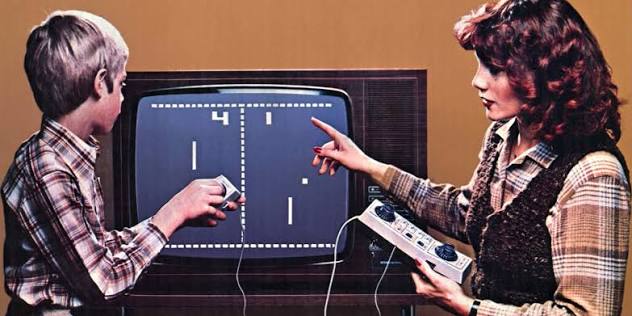
Pong was a simple electronic version of table tennis.
Players controlled vertical paddles and attempted to hit a ball back toward their opponent.
The concept was incredibly easy to understand.
That simplicity was one of its greatest strengths.
Pong became a major commercial success and helped prove that video games could become a viable entertainment business.
Arcades began appearing in more locations, and video games started becoming part of popular culture.
The industry had officially begun to take shape.
From Experiments to an Entire Industry
The journey from early experiments to modern gaming took only a few decades.
In the 1950s, scientists were using laboratory equipment to create extremely simple interactive experiences.
By the 1970s, arcade machines were appearing in public spaces.
By the late 1970s and 1980s, home consoles were becoming increasingly popular.
Then came the era of Nintendo, Sega, Sony, Microsoft, PC gaming, online multiplayer, mobile games, and eventually today’s enormous open-world titles.
The technology changed dramatically.
The basic idea didn’t.
A player interacts with a digital world and influences what happens inside it.
So, What Was Actually the First Video Game?
There isn’t one universally accepted answer.
If we’re talking about an early computer-based game, OXO from 1952 is one of the strongest candidates.
If we’re looking for an interactive electronic game designed to entertain visitors, Tennis for Two from 1958 is one of the most important milestones.
If we’re looking for an early computer game that resembles the competitive video games that followed, Spacewar! from 1962 is extremely significant.
And if we’re talking about the beginning of the commercial arcade industry, Computer Space and Pong are essential parts of the story.
Each represents a different stage in the evolution of video games.
Why This History Still Matters
It’s easy to look at a modern game and forget how far the technology has come.
A game today can contain enormous maps, thousands of characters, realistic physics, sophisticated artificial intelligence, and detailed environments.
The earliest games had none of that.
Yet the basic concept was already present.
Someone presses a button.
Something happens on a screen.
The player reacts.
The game responds.
That simple interaction eventually became one of the world’s largest entertainment industries.
Final Verdict
So, what was the first video game in history?
There is no single answer that everyone agrees on.
OXO, Tennis for Two, and Spacewar! are among the most important early milestones, while Computer Space and Pong helped transform experimental technology into a commercial industry.
Rather than having one single “first game,” video game history is better understood as a chain of inventions.
Each experiment added something new.
And without those early pioneers, the games we play today might never have existed.
From a few dots moving across an oscilloscope to enormous virtual worlds rendered in real time, the evolution of gaming is one of the most fascinating technological journeys of the modern era.