
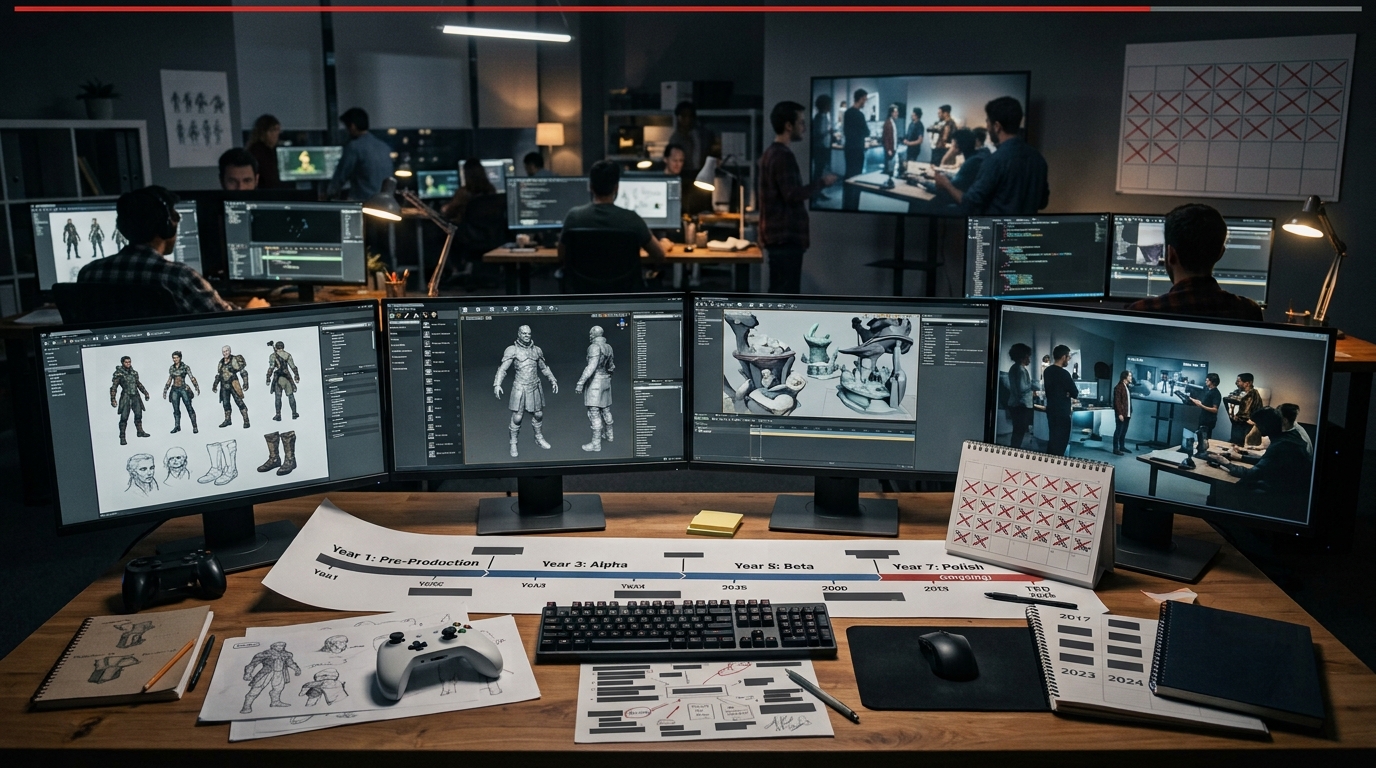
Why Do Video Games Take So Long to Release Today?
There was a time when video games could be developed and released in just a few years.
Today, some major games can take five, six, seven, or even more years to reach players.
This has become one of the biggest frustrations for gamers.
A game is announced, a trailer appears, everyone gets excited, and then…
Nothing.
Years can pass before the next major update.
But why does making a modern video game take so long?
The answer is much more complicated than simply saying that games have become bigger.
Games Have Become Much More Ambitious
One of the biggest reasons is simple: modern games are enormous.
A major AAA game can contain huge environments, detailed characters, thousands of animations, complex artificial intelligence, realistic physics, cinematic scenes, dynamic weather, extensive sound design, and hundreds of hours of development work.
Players expect games to feel like complete worlds.
A modern open-world game isn’t just a collection of levels.
It may need cities, roads, interiors, vehicles, animals, NPCs, missions, dialogue, weather, day-night cycles, side activities, and countless interactions.
Every additional system requires development, testing, and optimization.
Graphics Take More Time
Modern players expect incredibly detailed visuals.
Characters can have highly detailed faces, realistic clothing, complex hair, natural animations, and sophisticated lighting.
Environments also require enormous amounts of work.
A single building can involve models, textures, lighting, collision systems, animations, sound, and environmental details.
Now multiply that by an entire city.
The amount of work increases dramatically.
Games Are No Longer Just About Graphics
Visual quality is only one part of modern game development.
Developers also need to create sophisticated systems behind the scenes.
Modern games can include:
- Artificial intelligence
- Physics
- Animation systems
- Dialogue systems
- Inventory systems
- Combat systems
- Vehicle systems
- Multiplayer infrastructure
- Online services
- Dynamic worlds
- Save systems
- Accessibility features
- User interfaces
Each system needs to work individually.
More importantly, they all need to work together.
That is where development becomes extremely complicated.
More Developers Doesn’t Always Mean Faster Development
It might seem logical that adding more developers would make a game much faster to create.
But large teams create another challenge: communication.
A major game can involve hundreds or even thousands of people across different departments and locations.
Artists need to communicate with programmers.
Designers need to work with writers.
Animation teams need to coordinate with programmers.
Audio teams need to synchronize their work with gameplay.
Level designers need to understand technical limitations.
The larger the team becomes, the more coordination is required.
Every Feature Creates More Work
Imagine a developer adds a simple feature.
It sounds easy.
But that feature may require:
- Programming
- Animation
- Sound
- Visual effects
- User interface changes
- Testing
- Localization
- Performance optimization
A seemingly small feature can therefore create work for several departments.
And if the feature interacts with other systems, the amount of testing increases even more.
Testing Has Become Much More Complicated
Testing a modern game is a huge task.
Developers need to make sure missions work.
They need to test different characters, weapons, vehicles, environments, animations, save states, difficulty settings, languages, and hardware configurations.
Open-world games make this even harder because players can do things in unexpected orders.
A player might complete an activity before starting a mission.
They might arrive at a location using a completely different route.
They might interact with an object at a strange moment.
The game needs to handle as many of these situations as possible.
Bugs Can Take Months to Fix
Not every bug is easy to solve.
Sometimes a problem can be fixed in minutes.
Other times, developers have to investigate a complicated chain of systems to discover why something is happening.
A bug might appear only under very specific circumstances.
For example, an issue might occur only when a particular mission is active, during a specific weather condition, with a certain character, after the player has completed another activity.
Finding the cause can be much harder than finding the symptom.
Modern Games Are Built for Multiple Platforms
Many games are developed for more than one platform.
That can increase development complexity.
A game may need to work properly across different consoles and PC configurations.
Developers have to consider different hardware capabilities, memory limitations, performance targets, control schemes, resolutions, and technical requirements.
Optimizing a game for one specific configuration can be challenging.
Doing it across multiple platforms is another level of complexity.
Online Games Add Another Layer
Games with online features can take even longer.
Developers need to create servers, matchmaking systems, account systems, security measures, networking technology, updates, and systems designed to handle large numbers of players.
Even after launch, development doesn’t necessarily stop.
Online games can continue receiving new content and technical updates for years.
This means some modern games are effectively developed throughout their entire lifespan.
Players Expect More Content
Expectations have changed.
Players don’t just want a game that works.
They often expect large maps, extensive stories, side missions, customization, multiplayer features, photo modes, accessibility options, impressive graphics, and plenty of things to do.
The amount of content expected from major releases has grown significantly.
More content means more