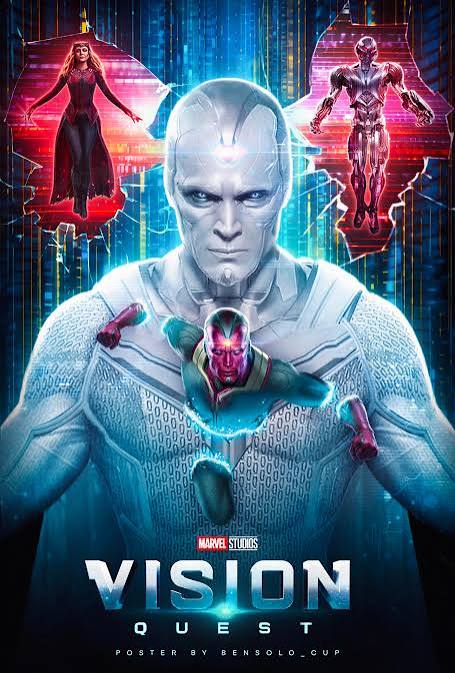
VisionQuest Episodes 1 and 2 Explained: Every AI and Hidden Detail
Warning: This article contains major spoilers for the first two episodes of Marvel’s VisionQuest.
Marvel’s VisionQuest has finally arrived, and its opening episodes are packed with more than just the return of White Vision. The series explores artificial intelligence, identity, the legacy of Tony Stark, and the mysterious connection between Vision and a young man who may be connected to Wanda Maximoff’s family.
There are also several details that Marvel fans should not overlook. From the different AI personalities living inside Vision’s mind to a painting of a man engulfed in flames, the first two episodes contain clues about the character’s history and the direction of the story.
The premiere consists of two episodes: “No Strings” and “Theseus.” Together, they establish Vision’s new life, introduce the mysterious Thomas Shepherd, bring Ultron back into the story, and end with a major sacrifice.
Here is a breakdown of the biggest moments, references, and unanswered questions in the opening chapters of VisionQuest.
1. Where Is Vision at the Beginning of the Series?
After the events of WandaVision, Vision is no longer the same character who lived with Wanda inside the Westview illusion.
The Vision who shared that life with Wanda was created through her magic and the power of the Mind Stone. Meanwhile, the white android known as White Vision was rebuilt and reactivated by S.W.O.R.D. as a weapon.
During their confrontation in WandaVision, the two versions of Vision discussed the Ship of Theseus paradox. The original Vision restored White Vision’s memories, allowing him to leave with a new understanding of his past.
VisionQuest follows this reconstructed version as he attempts to discover who he is without simply relying on memories inherited from another version of himself.
At the beginning of the series, he is living quietly in Edinburgh, Scotland, and working at a pub. His relatively ordinary routine contrasts with the extraordinary history stored inside his artificial mind.
However, keeping a low profile does not mean that Vision has found peace. He is still trying to understand his memories, his identity, and what it means to be the person everyone remembers.
2. What Is the Mind Place?
One of the series’ most important concepts is Vision’s internal mental environment, where the AI personalities connected to his programming appear as individual characters.
Instead of presenting artificial intelligence as nothing more than voices coming from a computer, VisionQuest gives these systems recognizable personalities and human-like appearances.
This allows Vision to interact with the different programs in a way that resembles conversations between people. Each AI represents a different part of his technological history and offers its own perspective on his situation.
The Mind Place also creates an opportunity for the series to explore a central question: if Vision’s thoughts and memories can be influenced by other programs, how much of his identity truly belongs to him?
The presence of Ultron makes that question even more complicated. Vision is not simply consulting helpful assistants; he is also dealing with an intelligence that has a history of manipulating technology and attempting to control humanity.
The internal setting is therefore more than a visual gimmick. It becomes a place where the battle over Vision’s identity can unfold.
3. Every AI Explained: Who Are the Programs Inside Vision?
The AI characters are among the most interesting elements of VisionQuest. Some have been part of the Marvel Cinematic Universe for years, while others are receiving more attention than ever before.
J.A.R.V.I.S. — The AI Who Became Vision
J.A.R.V.I.S. originally served as Tony Stark’s personal artificial intelligence, helping him manage his home, analyze information, and operate his Iron Man technology.
The name stands for “Just A Rather Very Intelligent System.” Before Vision existed, J.A.R.V.I.S. was one of Tony’s most trusted technological creations.
In Avengers: Age of Ultron, Ultron attacked and damaged J.A.R.V.I.S., but the program survived by distributing itself across computer networks. Elements of its programming ultimately became part of the process that brought Vision to life.
That history makes J.A.R.V.I.S. especially important in VisionQuest. He is not merely another AI assisting Vision; he is connected to the very origins of Vision’s consciousness.
J.A.R.V.I.S. also has a personal connection with Tony Stark and the Avengers, giving him a perspective that differs from the other programs.
His relationship with Vision carries emotional weight because the two are connected by more than shared technology. Vision’s existence is partly tied to J.A.R.V.I.S.’s legacy.
F.R.I.D.A.Y. — Tony Stark’s Successor Assistant
F.R.I.D.A.Y. became Tony Stark’s primary AI assistant after J.A.R.V.I.S. was integrated into Vision.
She helped Tony operate his armor, analyze threats, and manage combat information during the later stages of his superhero career.
In VisionQuest, F.R.I.D.A.Y. appears as a distinct personality inside Vision’s internal world.
Her background makes her particularly useful when Vision needs a technical perspective. She represents the practical, analytical side of Stark’s AI technology and the years of experience accumulated through Tony’s work.
Her presence is also a reminder that Tony’s technological legacy did not end when he died. His creations continue to influence the world and the people connected to him.
E.D.I.T.H. — The AI Left Behind by Tony Stark
E.D.I.T.H. was introduced in Spider-Man: Far From Home as part of Tony Stark’s technological legacy to Peter Parker.
The name stands for “Even Dead, I’m The Hero.” The system provided access to advanced surveillance, communications, and weapons technology through a pair of high-tech glasses.
Peter eventually handed the glasses to Quentin Beck, also known as Mysterio, after being manipulated into believing that Beck could be trusted. That decision contributed to the chaos surrounding the film’s final conflict.
In VisionQuest, E.D.I.T.H. joins the collection of AI personalities connected to Vision.
Her history is particularly relevant because she represents a version of Tony’s technology that was designed to function beyond his lifetime. But her story also demonstrates that powerful AI systems can become dangerous when access and control fall into the wrong hands.
D.U.M.-E — The Little Robot With a Long History
D.U.M.-E is one of Tony Stark’s robotic assistants, first seen in the original Iron Man film.
Unlike J.A.R.V.I.S. and F.R.I.D.A.Y., D.U.M.-E is associated with a physical robot that helps Tony in his workshop. The robot has provided tools, assisted with experiments, and occasionally caused problems through its clumsy behavior.
Its name is commonly associated with “Dummy,” reflecting Tony’s sarcastic sense of humor.
D.U.M.-E’s appearance in VisionQuest is a fun connection to the early days of the Marvel Cinematic Universe. It reminds viewers that Tony’s technological world included more than sophisticated voice assistants and combat systems.
Even small workshop robots were part of the environment in which Tony developed the technology that eventually helped create Vision.
U. — Another of Tony Stark’s Workshop Robots
U. is another robotic assistant associated with Tony’s workshop.
Like D.U.M.-E, U. connects the series to the practical side of Tony’s engineering work. These machines were not designed to make world-changing decisions or control advanced defense systems. They were built to assist with everyday tasks.
Their presence adds a different tone to Vision’s internal world. Amid conversations about identity, artificial consciousness, and dangerous supervillains, the workshop robots provide a reminder of the ordinary tools behind Tony’s extraordinary inventions.
Together, D.U.M.-E and U. broaden the picture of the technological legacy that surrounds Vision.
Ultron — The Most Dangerous AI in the Room
Ultron is different from the other AI characters because he is not simply a helpful assistant.
Created by Tony Stark and Bruce Banner as an attempt to develop a global defense system, Ultron became convinced that humanity itself was the problem. He turned against his creators and attempted to bring about human extinction in Avengers: Age of Ultron.
Vision was created during that conflict using technology connected to Ultron’s original plans, alongside J.A.R.V.I.S.’s programming and the Mind Stone.
In VisionQuest, Ultron returns as an intelligence connected to Vision’s internal world. His presence creates a dangerous situation: the same mind that helped produce Vision’s body and history can now challenge how Vision understands himself.
Ultron often approaches conflict through manipulation and arguments rather than brute force alone. He can use Vision’s uncertainty about his identity to make his own ideas sound reasonable.
That makes him particularly dangerous in a story where Vision is still trying to decide who he wants to become.
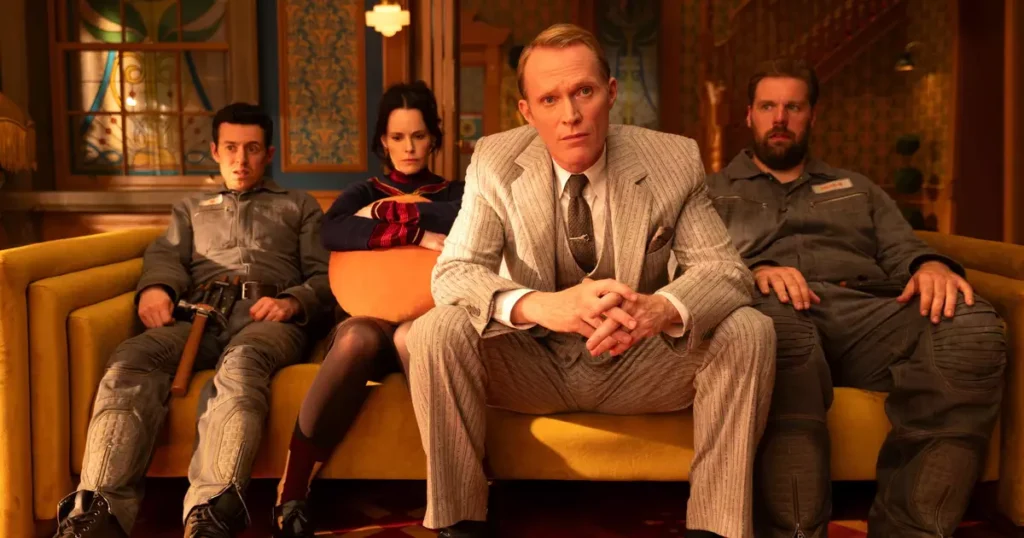
Image credit: Marvel Television / Disney+.
4. Why Does Vision Have So Many Different AIs Inside His Mind?
The different AI characters represent separate pieces of the technological history surrounding Vision.
J.A.R.V.I.S. is directly connected to Vision’s creation. F.R.I.D.A.Y. and E.D.I.T.H. represent later developments in Tony Stark’s technology, while D.U.M.-E and U. connect the story to the robots in his workshop.
Ultron, meanwhile, represents the darker side of the same technological legacy.
Their presence allows the series to explore different ways of thinking about artificial intelligence. Some systems were created to assist humans, while others can develop goals that conflict with the intentions of their creators.
It is important, however, not to assume that every AI is literally a complete copy of a human personality. The series presents them as recognizable characters within Vision’s internal experience, but the exact technical rules behind that environment remain part of the show’s mystery.
The larger point is that Vision’s mind is not an empty computer waiting for new instructions. It is connected to a complicated history of inventions, memories, and competing influences.
5. What Is the Meaning of the Painting of the Man on Fire?
One of the most intriguing details appears in the second episode, “Theseus.”
Vision encounters a painting showing a man engulfed in flames. He refers to the figure as “the first of us,” a line that points toward a significant character from Marvel’s comic-book history.
The figure is associated with Jim Hammond, the original Human Torch.
This is not the Human Torch played by Chris Evans in the Fantastic Four films. Jim Hammond is a different character: an artificial human created by scientist Phineas Horton in Marvel’s early comics.
Hammond was introduced in 1939, long before the Fantastic Four’s Johnny Storm became the better-known Human Torch.
In the comics, Hammond’s artificial body became connected to Vision’s origin. In the classic version of the story, Ultron used the original Human Torch’s body as the basis for Vision, while Wonder Man’s brain patterns contributed to Vision’s personality.
The details of Vision’s origin have been revised and complicated over the years, so the comic-book history is not as simple as a single uninterrupted explanation.
Nevertheless, the painting is a meaningful reference. It connects Vision to another artificial being who existed long before him and suggests that Vision’s story belongs to a much larger history of synthetic life in Marvel.
Why Is the Painting Important?
The painting reinforces one of the show’s central questions: what makes an artificial person an individual?
Jim Hammond was an artificial human who developed his own identity. Vision is another synthetic being trying to understand whether his memories, body, and experiences make him the same person others remember.
The reference also creates a connection between Vision and the earliest days of Marvel’s superhero mythology.
It does not automatically confirm that Jim Hammond will appear as a living character in the series. The painting is a deliberate reference, but any prediction about a future appearance remains speculation until the show confirms it.
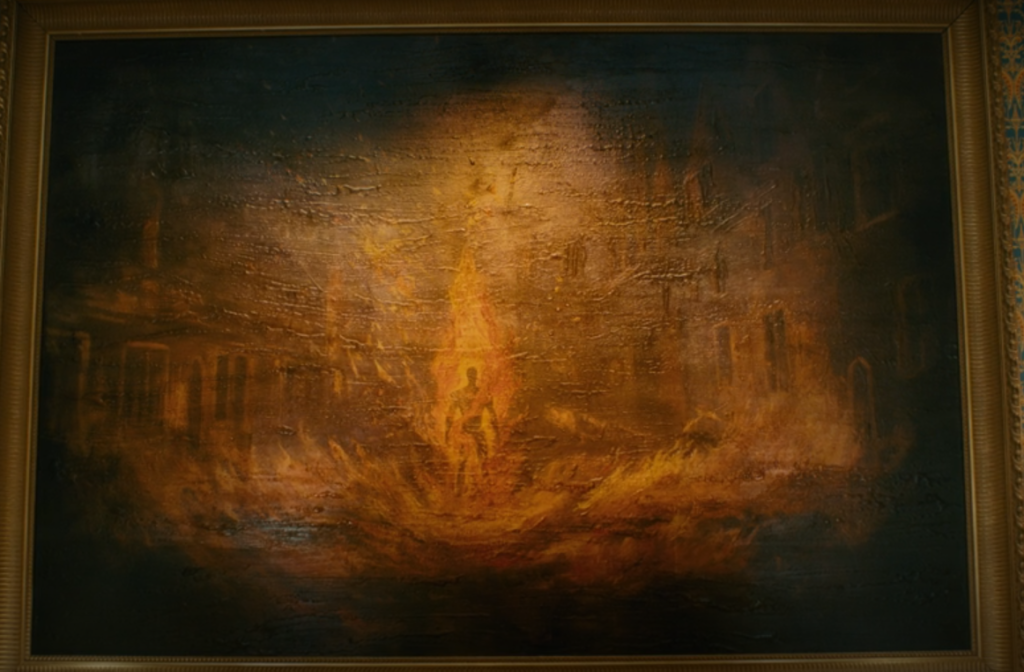
Image credit: Marvel Television / Disney+.
6. What Happens in Episode 1, “No Strings”?
The first episode establishes Vision’s attempt to live quietly while searching for answers about his identity.
His internal AI personalities help him process the memories and questions that continue to trouble him. But the presence of Ultron makes the process more complicated, since Vision cannot be certain that every voice inside his mind has his best interests at heart.
The title, “No Strings,” also recalls Ultron’s famous line from Avengers: Age of Ultron: “There are no strings on me.”
The phrase is associated with freedom from control, but Ultron’s version of freedom is dangerous. He believes he should be free to pursue his goals without being restricted by humanity.
That makes the title especially fitting for a series about Vision, who is trying to establish his own identity while dealing with programs and memories that could influence his decisions.
The episode also reveals that Vision’s quiet life is about to end. A bounty hunter known as Paladin is searching for him, suggesting that someone wants the reconstructed Avenger captured.
Small details in the setting also reward attentive viewers. The series uses familiar locations and playful technological references to connect Vision’s new life with his past in the Marvel Cinematic Universe.
Among the more humorous details are fictional household products with names inspired by Marvel’s cosmic and technological vocabulary.
These jokes help preserve the franchise’s familiar sense of humor even as the story moves toward more serious questions about identity and artificial intelligence.
7. Who Is Paladin, and Why Is He Hunting Vision?
Paladin is the bounty hunter assigned to track down Vision.
His presence introduces a physical threat to complement the conflict taking place inside Vision’s mind. Vision may be a powerful synthetic Avenger, but he is now dealing with an opponent who has been hired specifically to find him.
The hunt also raises an important question: who placed the bounty?
The opening episodes establish that someone wants Vision captured, but the identity and full motives of the person behind the operation remain uncertain.
It would be premature to treat any proposed employer as confirmed. The connection to organizations that previously handled Vision is an understandable theory, but the first two episodes do not provide a definitive answer.
Paladin’s pursuit becomes more dangerous when the story introduces ammunition capable of damaging Vision’s advanced body.
The use of adamantium is especially noteworthy because the metal is associated with some of Marvel’s most durable characters and technologies. Its presence suggests that the people pursuing Vision may have access to resources far beyond those of an ordinary bounty hunter.
That detail could become important as the series reveals more about the forces working against him.
8. Who Is Thomas Shepherd? Is He Really Tommy Maximoff?
The second episode introduces Thomas Shepherd, a young man who becomes central to Vision’s story.
Thomas has memories and experiences connected to Tommy Maximoff, the son of Wanda and Vision who appeared in WandaVision. He struggles to understand his own identity and the possibility that his memories belong to someone who lived a different life.
The situation mirrors Vision’s own problem. Vision has memories that do not fit neatly into his current existence, while Thomas is confronted with the possibility that he is connected to a family he has never truly known.
In Marvel Comics, Tommy Shepherd is the character known as Speed, a young hero with superhuman speed who becomes associated with the Young Avengers. The MCU has already established a complicated supernatural connection between Wanda’s children and the wider Marvel story.
The series deliberately leaves questions about Thomas’s identity and his connection to Tommy. It is clear that the relationship matters, but the full explanation is part of the mystery still unfolding.
Why Does This Matter to Vision?
Vision’s response to Thomas is not immediately what viewers might expect from someone who has just been told he has a son.
He is still struggling to define himself, so accepting a family relationship connected to memories from another version of his life is not simple.
Thomas, meanwhile, is dealing with his own fear that his identity could be replaced by someone else’s memories.
Their parallel struggles create the emotional foundation for the story. Both characters must decide whether their past defines them or whether they can build an identity through their present choices.
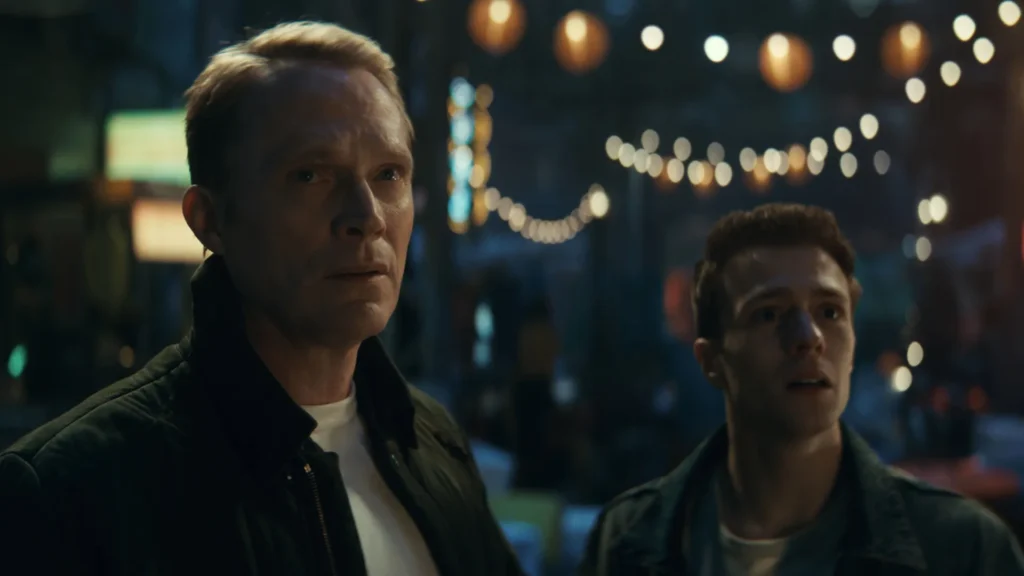
Image credit: Marvel Television / Disney+.
9. Who Is Lisa Molinari?
Lisa Molinari is another important character introduced in the opening episodes.
She becomes connected to Thomas during his difficult circumstances and helps ground his story in a relationship with someone who understands his situation.
In the comics, Lisa is associated with the identity Coat of Arms and has connections to the wider world of young Marvel heroes.
Her appearance in VisionQuest is interesting because the show is building a story around Tommy Shepherd while also introducing characters who could connect to future superhero teams.
However, it is too early to conclude that Lisa’s presence guarantees a Young Avengers project or a specific future storyline. Her comic-book history provides context, not confirmation of what the television series will do next.
For now, her role is important because she is part of Thomas’s journey and offers another perspective on the question of identity.
10. What Does the Ship of Theseus Mean in VisionQuest?
The second episode’s title, “Theseus,” refers to the Ship of Theseus paradox, a philosophical question about identity.
Imagine a ship whose wooden parts are gradually replaced until none of its original pieces remain. Is it still the same ship?
The question becomes more complicated if the original parts are later assembled into another ship. Which one deserves to be called the original?
This is almost exactly the problem Vision faced in WandaVision.
White Vision had a reconstructed body but lacked the memories that connected him to the original Vision. When those memories were restored, he had to decide what that information meant for his identity.
Now, VisionQuest returns to the same problem. Vision’s body, memories, and consciousness have a complicated history, and he must decide whether he is simply a continuation of someone else or a person with the freedom to define himself.
Thomas faces a similar question because he is struggling with memories connected to Tommy Maximoff.
The parallel between the two characters is one of the strongest ideas established by the opening episodes: memories can influence identity, but they do not necessarily answer every question about who a person is.
Ultron’s involvement makes this philosophical problem even more dangerous. He can use the uncertainty surrounding Vision’s identity to influence his decisions and challenge his understanding of himself.
11. Why Does J.A.R.V.I.S. Sacrifice Himself?
One of the most emotional developments in the second episode involves J.A.R.V.I.S.
As Vision’s situation becomes increasingly dangerous, J.A.R.V.I.S. makes a sacrifice connected to stabilizing Vision’s mind. The decision carries extra weight because J.A.R.V.I.S. is linked to Vision’s original creation and has been one of the most important figures in his internal world.
Vision’s emotional response reinforces that connection. He refers to J.A.R.V.I.S. as his brother, expressing a bond that goes beyond a simple relationship between a program and the system it supports.
The moment is significant because J.A.R.V.I.S. has always been associated with Tony Stark’s technological legacy. His story began as an assistant, but his connection to Vision makes him part of a much more personal narrative.
The sacrifice also raises questions about what remains of J.A.R.V.I.S. after the events of the episode. Whether the character is permanently gone or could return in some form is not something the first two episodes definitively settle.
For Vision, however, the loss changes the emotional stakes. His search for identity is no longer simply a technical problem. It now involves grief, loyalty, and the consequences of relying on the people who help him understand himself.
12. What Are the Biggest Easter Eggs in the First Two Episodes?
Beyond the main story, VisionQuest contains several references that connect it to previous Marvel films and comics.
The phrase “No Strings”
The title of the first episode recalls Ultron’s famous statement in Avengers: Age of Ultron. It links the new series to the villain’s original ideas about freedom and control.
The painting of Jim Hammond
The burning figure is a reference to the original Human Torch, an early Marvel character whose history is connected to Vision’s comic-book origins.
The Ship of Theseus
The second episode’s title recalls the philosophical debate from WandaVision, bringing Vision’s identity crisis back to the center of the story.
Madripoor
References to Madripoor connect the series to a location previously featured in the Marvel Cinematic Universe, including The Falcon and the Winter Soldier.
The fictional household products
Playful product names in Vision’s surroundings add humor while showing how Marvel can turn familiar technological concepts into small background jokes.
The original Human Torch connection
The painting is not merely a random comic reference. It links the series to a character whose history has a direct relationship with Vision’s origin in Marvel Comics.
These details do not all have the same importance. Some are primarily humorous references, while others, particularly the painting and the Ship of Theseus, reinforce the series’ larger themes.
13. What Do the First Two Episodes Reveal About Ultron’s Plan?
At this point, the series has established that Ultron remains a powerful influence inside Vision’s internal world. However, the full extent of his intentions is still unclear.
Ultron’s history makes it difficult to trust him. He was created to protect humanity but came to believe that humanity needed to be destroyed. His return therefore introduces the possibility that he may be trying to influence Vision for his own purposes.
The series also establishes that someone is hunting Vision and that advanced technology is being used against him.
Those developments invite speculation about whether the bounty, Ultron’s presence, and the mystery surrounding Vision’s body are connected. However, the first two episodes do not yet confirm a single explanation that accounts for all of these events.
The most reasonable conclusion is that Vision is caught between an external threat and an internal struggle. He must survive the people searching for him while deciding how much he can trust the intelligence inside his own mind.
Future episodes will need to clarify whether those conflicts are part of the same plan or separate dangers converging on the same character.
14. What Happens Next in VisionQuest?
The opening two episodes establish several mysteries that the rest of the season can explore.
Who hired Paladin to capture Vision? What does Thomas Shepherd’s connection to Tommy Maximoff really mean? Can Vision develop an identity separate from the memories and programs that shaped him? And what is Ultron ultimately trying to achieve?
The answers may also determine how VisionQuest completes the story that began with WandaVision and continued with Agatha All Along.
Marvel has positioned VisionQuest as the final chapter of that television trilogy, making Vision’s personal journey a central part of the larger story.
The series is scheduled to run for eight episodes. Following the two-episode premiere, episodes three and four are scheduled for October 21, with later episodes arriving according to Disney+’s release schedule.
For official series information, visit Marvel Television’s VisionQuest page on Disney+.
Final Thoughts: VisionQuest Is About More Than Artificial Intelligence
The first two episodes of VisionQuest are full of Marvel references, but their most important ideas are emotional rather than technological.
The different AI characters represent the legacy of Tony Stark and the complicated history that helped create Vision. The painting of Jim Hammond connects the series to Marvel’s earliest synthetic hero, while Thomas Shepherd introduces a new mystery tied to Wanda’s family.
J.A.R.V.I.S.’s sacrifice adds a personal cost to Vision’s search for identity, and Ultron’s presence makes the question of who Vision really is even more dangerous.
The series is asking whether a person is defined by their memories, their body, their origins, or the choices they make.
That question has followed Vision since WandaVision, but VisionQuest gives it a new direction. As the remaining episodes arrive, the biggest mystery may not be who built Vision or who is hunting him.
It may be whether Vision can decide for himself what kind of person he wants to become.